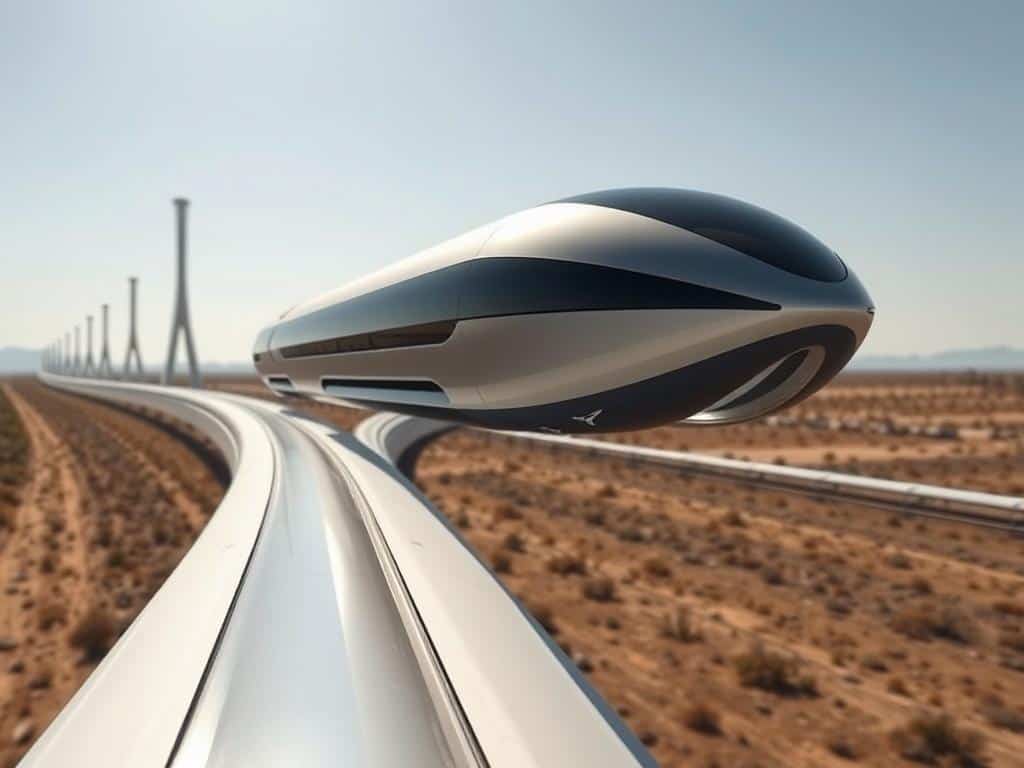
Did you know Hyperloop tech could change our daily trips? It could move people at speeds up to 1,220 km/h (758 miles/h). That’s quicker than a plane! Imagine going from Los Angeles to San Francisco in just 35 minutes.
This big idea started with Elon Musk in 2013. It wants to make a network of vacuum trains in tubes. This could make travel much faster and change how we see distance and connection.
Even though it’s not ready yet, many big companies are excited about it. They see it as a way to travel fast using green energy. The dream of fast, green travel is getting closer, and I’m eager to dive into the world of Hyperloop.
Key Takeaways
- Hyperloop could reduce travel time between major cities to mere minutes.
- The technology aims to use low-pressure tubes for high-speed transportation.
- Elon Musk’s vision for Hyperloop includes sustainability through renewable energy.
- Current developments showcase a mix of challenges and breakthroughs.
- The scale of investment and infrastructure required remains a topic of debate.
- Multiple companies are exploring the feasibility of Hyperloop systems globally.
Understanding the Concept of Hyperloop Technology
Hyperloop technology has caught the attention of many, blending history with innovation. It started in the 19th century with Isambard Brunel’s vacuum trains. These early attempts at vacuum propulsion laid the groundwork for today’s high-speed transport ideas.
The Origins of Hyperloop Technology
Isambard Brunel and Robert Salter first dreamed up Hyperloop. They wanted to make travel more efficient. Their ideas led to the vacuum tube concept that defines Hyperloop today.
In 2013, Elon Musk brought new life to the idea with Hyperloop Alpha. He showed how low-pressure tubes could speed up travel.
Elon Musk’s Vision
Elon Musk sees Hyperloop as more than just fast travel. He wants to connect cities quickly, cutting down travel times. For example, he plans to link Los Angeles and San Francisco in just 35 minutes.
Musk wants to make Hyperloop open to all, not just private companies. His design uses magnetic levitation and vacuum tubes for speed and efficiency. He hopes to make travel faster and greener, reducing environmental harm.
Current Developments in Hyperloop Technology
Hyperloop systems are advancing fast around the world. This shows a bright future for how we travel. Many companies are working hard to make Hyperloop a big part of our transportation.
The Hyperloop Association was started by seven companies. It’s the first group worldwide focused on Hyperloop innovation.
Recent Breakthroughs Worldwide
There have been big steps forward in Hyperloop tech. For example, Virgin Hyperloop tested a pod with two people inside. They reached high speeds, promising to make travel much faster.
Spain’s Zeleros got over €7 million to work on its Hyperloop system. They aim to make Hyperloop a new way to travel.
The Hyperloop Certification Center in West Virginia could bring in a lot of jobs. It also meets new rules from the USDOT and NETT Council. This shows the U.S. is serious about Hyperloop.
The Role of Major Companies
Big Hyperloop companies are leading the way in fast travel. Virgin Hyperloop tested its “DevLoop” pod at over 240 miles per hour. This shows their dedication to Hyperloop.
In 2022, Hyperloop Transportation Technologies got $80 million from investors. This money will help build the needed infrastructure.
Projects like the Mumbai–Pune Hyperloop in India show these companies’ global reach. With speeds over 700 miles per hour, travel times will drop dramatically. This will make traveling much more efficient.
Challenges Facing Hyperloop Technology
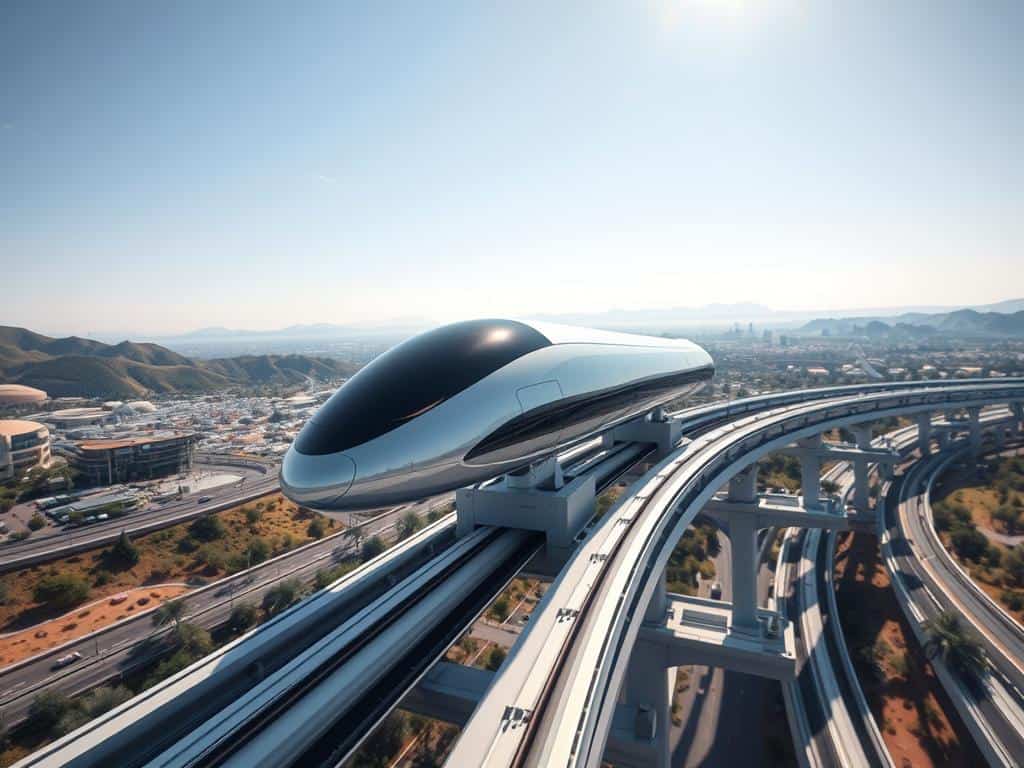
The journey to make Hyperloop technology a reality is filled with hurdles. These challenges include high infrastructure costs and technical obstacles. Companies are hopeful, but many factors could affect its success.
Infrastructure Costs and Technical Hurdles
Creating a Hyperloop system needs careful planning and a lot of money. Finding land and getting rights of way is hard, even more so in cities. The 1.5-mile Las Vegas loop, for example, cost about $50 million, not counting the Hyperloop tech itself.
This shows the huge financial challenge of setting up the needed infrastructure. Keeping the tubes air-tight over long distances is also a big technical problem. It requires advanced engineering and a lot of energy to keep the tubes depressurized.
Finding a balance between cost, efficiency, and practicality is key. Developers must tackle these concerns to move forward.
Safety Concerns
Keeping Hyperloop safe is another big challenge. There are risks with pods going at speeds close to 700 mph in sealed tubes. Problems like technical failures or outside factors could be dangerous for passengers.
As speeds get higher, controlling pressure and vibrations gets harder. This makes keeping the system safe even more complicated. The physical effects of fast starts and stops also add to the risks. To protect passengers, strict safety rules and protocols are needed.
Without clear safety standards or places to test, moving the project forward is tough.
Conclusion
The future of Hyperloop technology is very promising. It could change how we travel around the world. With speeds over 1,200 km/h, it’s much faster than trains today.
But, we have big challenges to overcome. We need to figure out how to make it affordable and safe. This is key to making Hyperloop a reality.
Big companies are putting a lot of money into Hyperloop. It could make traveling faster and cleaner. The goal is to make it zero-emission, which is good for our planet.
The big question is when we’ll see the first Hyperloop system. I’m optimistic that we’ll solve the problems and make it work. This could lead to a better, more connected world.
