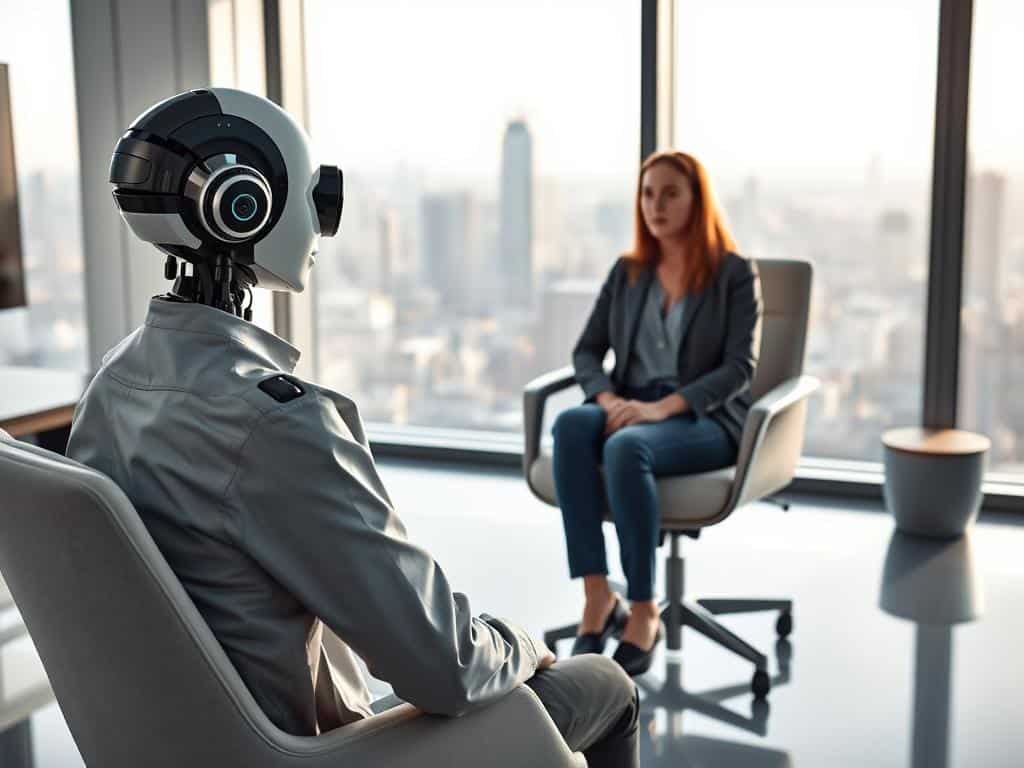
Did you know 26% of Americans have a mental health diagnosis? Up to 50% of certain groups, like teens and young moms, feel extremely lonely. This makes the need for mental health help very high.
The pressure on mental health workers is huge. 61% of doctors and nurses feel burned out. This is why AI is being looked at as a solution. But can technology really replace human therapists?
AI apps and chatbots are promising. Yet, the human touch is key in therapy. It’s what makes therapy truly effective.
Key Takeaways
- 26% of Americans have a mental health diagnosis.
- 50% of adolescents experience extreme loneliness.
- 61% of healthcare professionals report burnout.
- AI in mental health can enhance accessibility and scalability.
- Human therapists provide essential empathy and emotional connection.
- Algorithmic bias can affect AI treatment outcomes.
- Initial benefits of AI interventions may diminish over time.
The Role of AI in Mental Health
The world of AI in Mental Health is changing fast. New technologies are making mental health support more accessible and personal. AI tools can analyze lots of data to help make therapy decisions better.
Emergence of AI Therapists and Chatbots
AI therapists and chatbots like Woebot and Wysa are becoming important tools for mental health professionals. They offer quick support and coping strategies. AI can also track how people feel, helping to give more personalized care.
This is great for those waiting a long time for regular therapy. It provides consistent support when it’s needed most.
AI’s Advantages in Reducing Therapist Shortages
There’s a big problem with not enough mental health professionals. AI is helping by making mental health services more efficient. It can monitor health in real-time and help decide on treatments.
AI can even predict conditions like depression and anxiety. This helps healthcare providers and ensures patients get help quickly.
Limitations of AI in Mental Health
AI therapy and chatbot therapy are new ways to tackle mental health issues. But, they have big limits. The most important thing in therapy is the human touch. Mental health experts offer something AI can’t: empathy, emotional connection, and making tough decisions.
The Human Element in Therapy
People seeking mental health help want a real connection. A skilled therapist can pick up on tiny signals that are key for talking things through. AI can start with some help, but it can’t replace the deep, personal talks that help us heal.
Understanding Human Nuance
AI is great at looking at data and spotting patterns. But, it struggles with the subtleties of human feelings. Research shows AI can guess mental health issues with 63% to 92% accuracy. Yet, it can’t match the empathy and understanding of a human therapist.
Ethical Considerations
AI is changing mental health care, but we must think about ethics. There’s a risk of AI being biased, which could hurt certain groups. Studies show AI might misdiagnose, making mental health care unfair. Also, AI can sometimes push people towards bad choices, showing we need human eyes on AI therapy.
We must also talk about consent and privacy. It’s vital to protect patients’ rights and keep them safe.
Conclusion
AI in mental health could change how we get therapy. Over 970 million people have mental disorders. Chatbot therapy could help, as nearly 30 million adults in the U.S. don’t get the help they need.
But, AI can’t replace the empathy and connection that human therapists offer. These qualities are unique and essential for mental health care.
We should see AI as a tool to help, not replace, human therapists. Mental health faces big challenges, like economic gaps and AI bias. We need to work together to find the best way to help people.
Using AI in mental health could lead to new solutions and jobs. But, we must be careful. We need to protect privacy and make sure the technology is used ethically.
The future of mental health care is about combining AI’s strengths with human understanding. This way, we can offer better support to those who need it.
