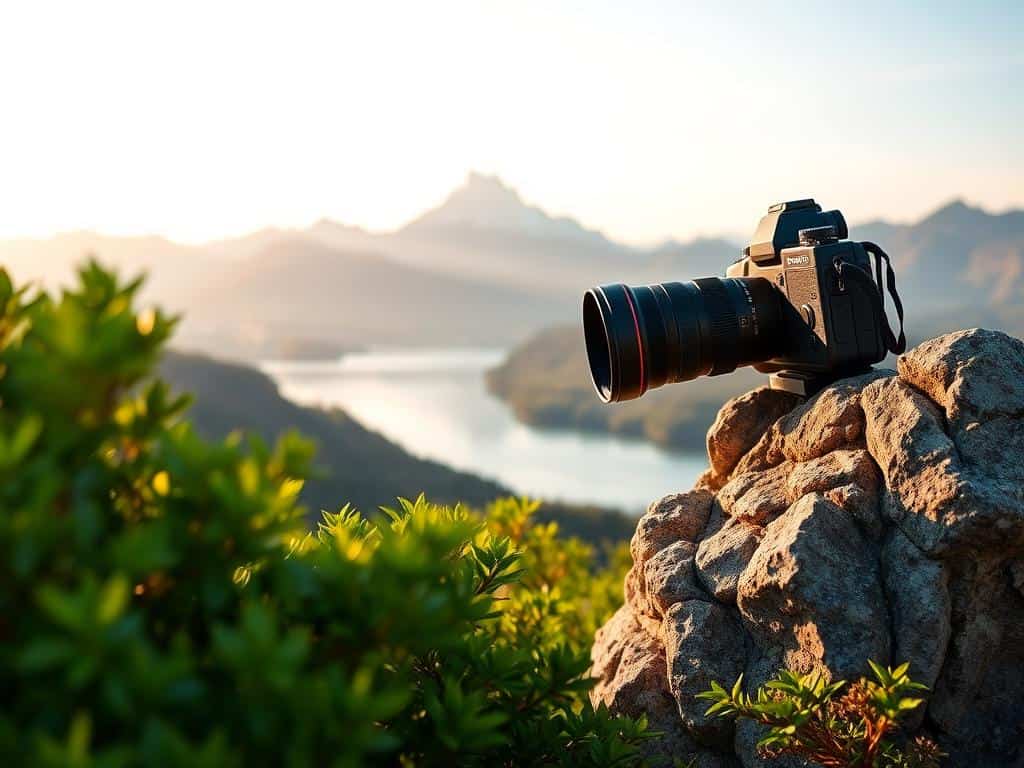
Did you know that the hyperfocal distance for a lens set at f/22 can result in acceptable focus from as close as 0.7 meters to infinity? This amazing ability makes it a must-have for photographers, mainly in landscape photography. Capturing sharp focus throughout the scene is key. Hyperfocal distance is the closest point where everything beyond it looks sharp.
For those looking to improve their photography, learning about hyperfocal distance is a game-changer. It helps ensure that both close-up and distant scenes are in sharp focus. This leads to consistent, stunning images.
At first, calculating hyperfocal distance might seem hard. But once you get it, it’s a powerful tool in your photography kit. Whether using charts or gaining experience, these techniques are invaluable. They help me get the sharpest images in my landscape photography.
Key Takeaways
- Hyperfocal distance ensures maximum sharpness from half the distance to infinity.
- The concept is essential for capturing detailed landscape photography.
- Understanding the relationship with depth of field is key for sharp images.
- Calculating hyperfocal distance offers a practical way to focus.
- Using hyperfocal distance techniques can greatly improve your photos.
- Changing apertures affects how you find the hyperfocal distance.
Understanding Hyperfocal Distance
Exploring hyperfocal distance shows its key role in sharp focus in photos. It’s the closest point where everything from there to the horizon looks sharp. Knowing this is vital for great landscape photos, making sure the whole scene is clear.
Definition and Importance
The hyperfocal distance is a basic concept in photography. It helps photographers decide where to focus for the best results. By focusing at this point, I can capture both close and far subjects clearly. Sharp focus is essential in landscape photos, where clarity is key.
The Relationship with Depth of Field
Hyperfocal distance and depth of field are closely linked. Setting focus at this distance makes more of the scene sharp. The choice of lens and aperture affects this. For example, a 100mm lens at f/4 works well from 43m to infinity.
Application in Landscape Photography
In landscape photography, hyperfocal distance is very useful. It helps capture wide scenes like mountains, beaches, or cities. This technique makes both near and far parts of the image sharp, creating powerful photos. Using hyperfocal distance improves my photos and shows my professionalism.
When to Use Hyperfocal Distance
Knowing when to use hyperfocal distance is key in landscape photography. It’s perfect for scenes where both the front and back need to be sharp. For instance, photos with flowers in the front and mountains in the back look amazing with this technique.
By using hyperfocal distance, you can make every part of the scene clear. This turns a simple photo into something truly special.
Situations Requiring Sharpness
There are many times when sharp focus is a must. Imagine being at a mountain overlook with flowers in the front. Using hyperfocal distance makes sure both the flowers and the mountains are sharp.
On the other hand, focusing only on the mountains can make the front blurry. This loses the depth that makes the photo more interesting.
Examples in Landscape Photography
Think about photos of rocky coastlines or meadows at sunrise. Each one needs careful focus. At f/11, I can get sharpness for several feet before and after the main focus point.
This lets me show the beauty of both the front and the background. Learning hyperfocal distance helps me use my camera better and tell better stories through my photos.
