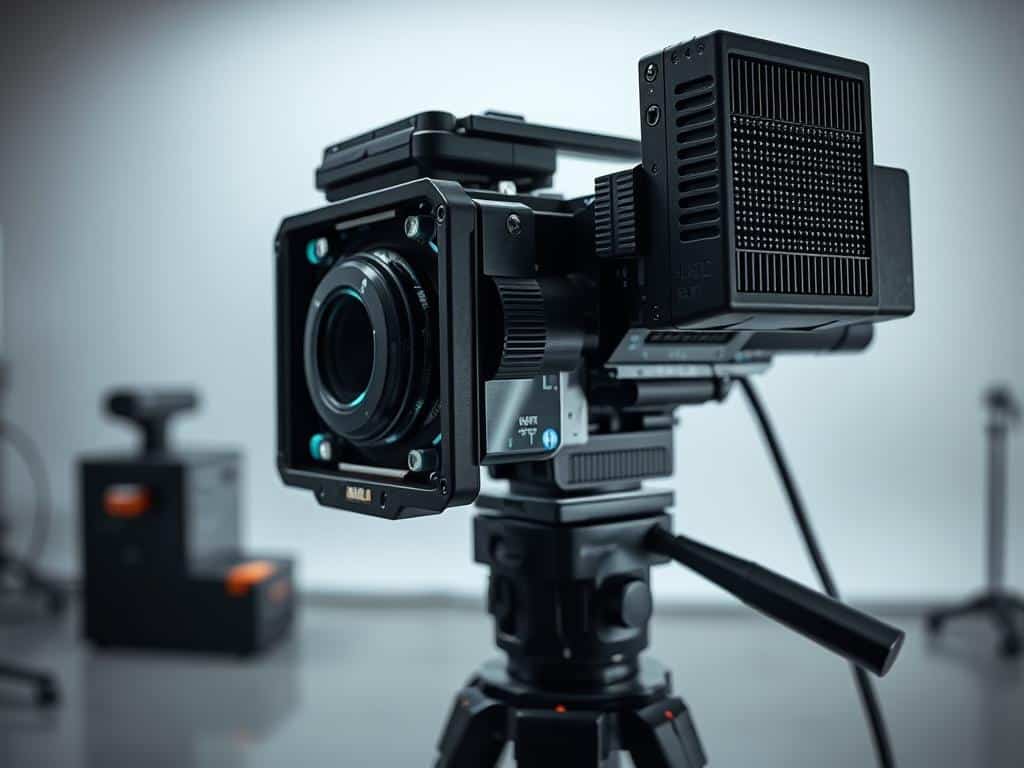
Did you know Time-of-Flight (ToF) cameras can measure distances with just a few millimeters of accuracy? This technology has grown a lot from the 1990s. Now, it’s key in fields like robotics and self-driving cars. It works by measuring how long it takes for light to go to an object and back, creating amazing depth mapping.
Companies like e-con Systems have led in 3D camera tech for over a decade. This focus on advanced photography is at an all-time high. As we dive into 3D mapping and ToF cameras, you’ll see they go beyond old imaging systems. They’re opening doors to new discoveries in many areas.
Let’s explore how ToF cameras are changing how we take pictures. And see the big impact they’ll have on our future.
Key Takeaways
- ToF cameras provide millimeter-level depth accuracy, improving images.
- Industry leaders like e-con Systems have over a decade of 3D camera tech expertise.
- This tech works well in different lighting and uses.
- ToF cameras change advanced photography with their quick response times.
- They’re used in many ways in robotics and self-driving systems, showing their versatility.
Understanding 3D Depth Mapping and Its Importance
3D depth mapping is a new way to see the world in 3D. It measures how far objects are from a sensor. This gives us important information that 2D pictures can’t.
What is 3D Depth Mapping?
3D mapping uses special technology to show us objects in space. It uses light and cameras to measure distances. This way, it can show us the world in a way that 2D pictures can’t.
Comparison of 3D Mapping Technologies
There are different ways to do 3D mapping, each with its own strengths and weaknesses. Stereo vision cameras use two lenses to figure out depth. They work well but can be tricky in certain lights.
Structured light imaging sends out light patterns and reads them back. This method makes very detailed maps, even in tight spaces. Time-of-Flight cameras, on the other hand, can take a full depth map in one shot. They’re fast and work well in moving scenes.
Applications of 3D Depth Mapping
3D depth mapping has many uses in different fields. In healthcare, it helps doctors check on patients from afar. It’s also used in farming to help robots pick the right fruits.
Security systems use it to count people. And robots can move around safely because of it. The DepthVista series from e-con Systems shows how it works in the dark, helping in all these areas.
Time-of-Flight Cameras: Technology and Benefits
Time-of-Flight (ToF) cameras are a big step forward in capturing depth. They measure how long light takes to get to an object and back. This lets them create detailed depth maps quickly.
They use special light sources, like VCSELs, to send out signals. These signals are then caught by sensors, giving us real-time data for fast processing.
How Time-of-Flight Cameras Work
ToF cameras use Near-Infrared light to figure out depth. They can measure depth with great accuracy, from 1mm to 1cm. This means they can make high-resolution depth images, like VGA resolution at 640×480 pixels.
They work fast, too, at 60 frames per second. This makes them perfect for tasks that need quick action, like in automation.
Benefits of Using Time-of-Flight Cameras
One big plus of ToF cameras is how affordable they are. They’re cheaper than LiDAR sensors or structured light cameras. Plus, they’re small, making them great for tiny devices, like smartphones.
They also work well in low light or darkness because they light themselves. But, they can struggle in very bright light, like outside in the day.
Real-World Applications of ToF Cameras
ToF sensors are used in many fields. In robotics and automation, they help sort things and guide robots. They’re fast, making them great for improving assembly lines and logistics.
In gadgets, they make photos look better by adding depth. Healthcare and cars are also using them for their accuracy in depth capture. This shows how useful ToF cameras are in many areas.
Conclusion
Reflecting on ToF camera advancements, it’s clear they’re more than just tools. They’re changing the game for depth mapping. Their ability to measure depth with millimeter precision is a game-changer in imaging tech.
Their growing use in gadgets shows how ToF cameras are a cost-effective, compact option. They’re making augmented reality and robotics better. This is a big deal for tech.
ToF cameras are great at mapping and detecting obstacles in real-time. They’re making things more efficient in many fields. Their ability to adapt to different settings is impressive.
It’s also good to see manufacturers focusing on privacy. They’re making sure the depth info they collect is safe and used right.
Looking ahead, the future for ToF cameras is bright. They’re getting better at what they do, and that’s exciting. I’m looking forward to seeing how they’ll keep changing our world.
