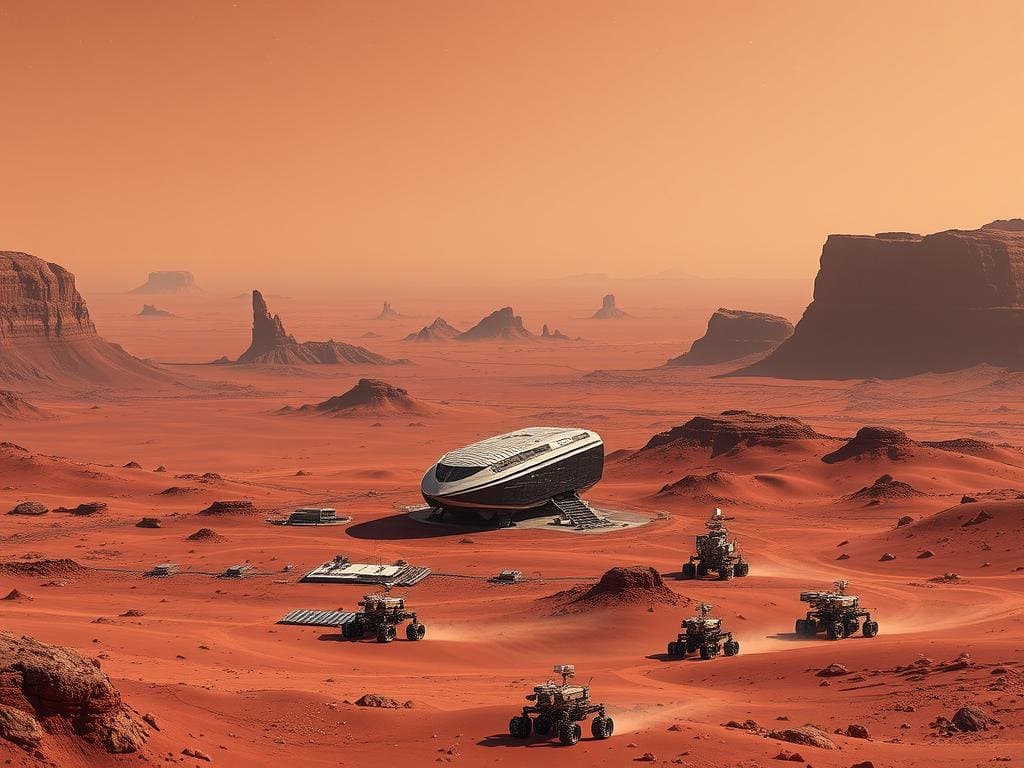
Imagine traveling over 1 billion miles to reach Mars. The distance from Earth to Mars can be anywhere from 33 million to 249 million miles. Living on Mars is no longer just science fiction. It’s becoming a real goal thanks to new technology and science.
Despite Mars taking nearly twice as long as a year to orbit the Sun, people are excited about living there. NASA plans to send humans to Mars in the 2040s. But, we need to figure out how to survive there.
Initiatives like the Mars Oxygen In-Situ Resource Utilization Experiment (MOXIE) are key. MOXIE aims to make oxygen from Mars’ atmosphere. This shows us how we might live on Mars and the challenges we’ll face.
Key Takeaways
- The distance from Earth to Mars varies widely, influencing mission planning and logistics.
- NASA aims to send astronauts to Mars by the 2040s, marking a significant milestone in space colonization.
- Advanced technologies, like MOXIE, will play a critical role in supporting human life on Mars.
- The challenges of living conditions on Mars present unique survival needs that require thorough exploration.
- The journey to Mars is estimated to take six to eight months, requiring careful preparation and support systems.
- Understanding the environmental factors is essential for successful long-term human habitation on Mars.
- Overall, establishing a sustainable colony on Mars involves extensive research and collaboration among various space agencies.
The Promise of Mars as a New Frontier
Mars is a thrilling goal in space exploration, full of scientific discoveries waiting to be made. It’s the closest planet that might have life, making it key for understanding our solar system and humanity’s future. Mars is about 33 million to 249 million miles from Earth, drawing the attention of many, including NASA.
The idea of settling on Mars, with its 24-hour day/night cycle and varied landscapes, excites and motivates people.
Why Mars is the Target for Space Exploration
Mars is fascinating because of its geology and atmosphere. Its atmosphere is mostly carbon dioxide, which is a challenge but also a chance for new technologies. NASA and others are working on using Martian resources for future missions.
Old missions like the Viking programs and the Curiosity rover have made Mars a more reachable goal for humans.
Current Missions and Technology Advancements
Colonizing Mars depends on NASA’s ongoing missions and new technologies. The Mars Oxygen In-Situ Resource Utilization Experiment (MOXIE) is a big step in making oxygen from the Martian air. Future missions aim to see if humans can live on Mars, with Mars One planning to send a crew by 2031.
New technologies like renewable energy, closed-loop life support, and 3D printing are essential for living on Mars long-term.
Challenges of Space Colonization on Mars
Exploring Mars colonization shows us the need for basic survival items. We must find water, food, shelter, and oxygen. These needs are hard to meet in Mars’ harsh environment.
Survival Needs on the Red Planet
Water is key, but it’s mostly ice. Getting this ice is a big challenge. Mars’ air, mostly carbon dioxide, makes breathing hard.
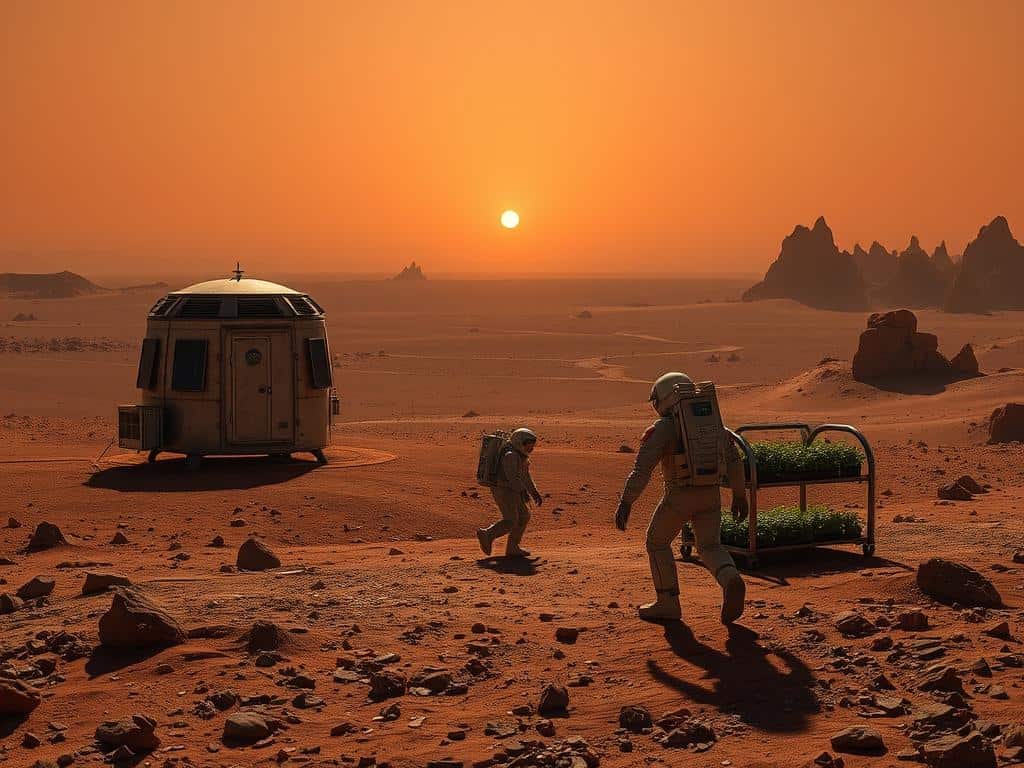
Creating food will also be tough. Ideas like vertical farming and aquaculture might help. They could provide food in Mars’ low gravity.
Environmental Factors Affecting Human Settlement
Dust storms and extreme temperatures are big hurdles. So are the two-week communication blackouts during solar conjunctions. Communication delays can be up to 24 minutes.
The thin Martian atmosphere makes landing hard. Mars’ gravity is only 3/8 of Earth’s. Astronauts will have to get used to this.
New technologies, like SpaceX’s retro-rockets, aim to solve these problems. They help with landing and safety. These advancements bring hope for Mars colonization.
Conclusion
The journey to Mars is full of hurdles, but our current efforts are laying the groundwork for humanity’s future. SpaceX, led by Elon Musk, is working to make space travel cheaper. They hope to make Mars colonization a real possibility soon.
A recent poll found that 56% of Americans think NASA will send humans to Mars by 2040. This shows how much people are excited and hopeful about this goal.
Exploring other planets is more than just reaching Mars. It’s about pushing science and technology to new heights. Our work in robotics, rocket science, and life sciences is key to overcoming space challenges.
By learning from projects on Earth that mimic Martian conditions, we’re getting closer to making life on Mars a reality. I believe our efforts will soon allow humans to live and grow beyond Earth.
While the timeline for Mars colonization is unclear, our drive to explore keeps us moving forward. Ongoing research and missions to study Mars will guide our journey through space. With the right investments and breakthroughs, making a human presence on Mars a reality is within reach.
