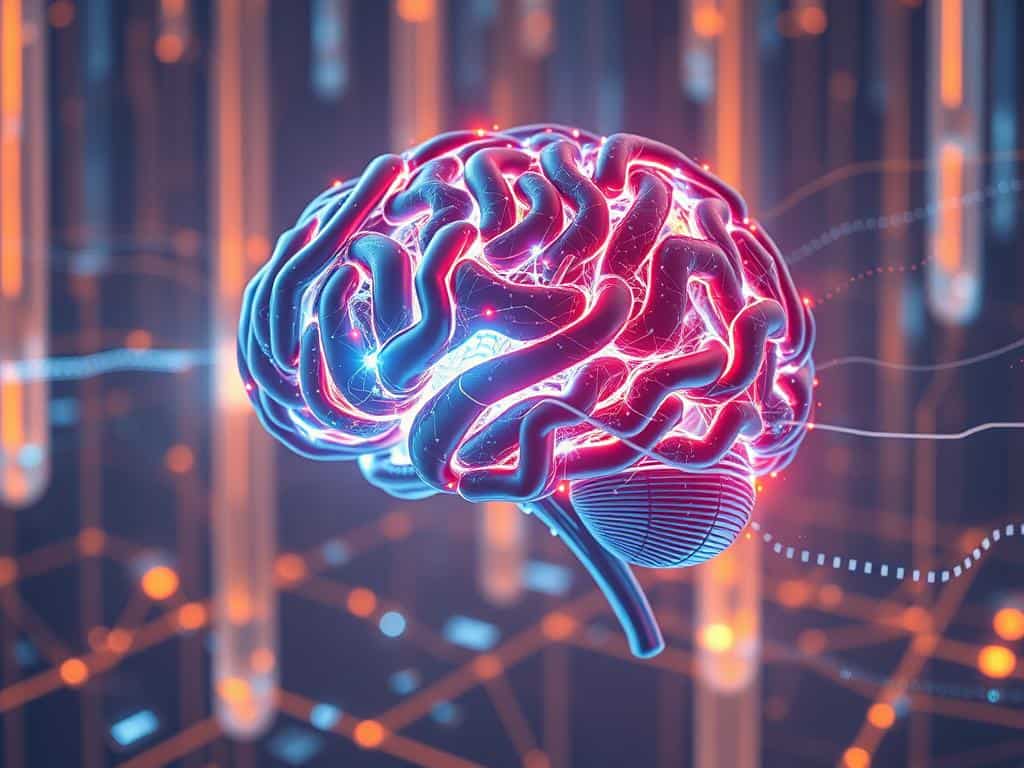
Did you know over 500 scientists worked on Europe’s biggest brain mapping project? They spent 10 years and €600 million but couldn’t map the brain’s basic structure. This shows how hard it is to understand our brains.
We’re far from making brain uploading a reality. This idea has excited scientists and dreamers for years. As I explore digital immortality, AI consciousness, and transhumanism, I see big questions. What if we could copy our minds into a digital world?
Thinkers like David Chalmers and Yuval Noah Harari believe in mind uploading. They make us think about what it means to be human. Is it just our memories and thoughts, or is there more to us?
Key Takeaways
- The largest brain mapping project in Europe faced significant challenges.
- Current neuroscience remains far from achieving true brain emulation.
- Ethical implications of mind uploading provoke thought on identity and consciousness.
- Transhumanism advocates for merging technology with human capabilities.
- Neurotechnology is rapidly evolving, yet practical applications lag behind.
- The timeline for brain uploading is uncertain and could span decades.
The Concept of Brain Uploading
Brain uploading is where tech meets philosophy, showing us how we might go beyond our bodies. It’s about making a digital copy of our minds, so our consciousness can live in a virtual world. Thanks to science and computing, the idea of living forever in a digital form is getting closer.
Understanding Brain Uploading
Brain uploading tries to copy the human brain’s complex design. It has about 90 billion neurons and over 100 trillion connections. Mapping these connections is a huge task, needing lots of data and analysis.
Biological neurons work at 200 Hz, but computers can do much faster. This makes creating a digital mind a big challenge. Yet, experts think it might be possible in a few decades, changing how we see ourselves and the world.
Historical Background and Evolution of the Idea
The idea of brain uploading comes from science fiction and real science. The Blue Brain Project started by simulating rat brains, showing it’s possible. Transhumanists see this as a key step toward living forever in a digital form.
Creating a digital human mind is a huge task. We need better imaging tech to capture the tiny details of neurons and connections. This challenge shows how hard it is to turn our consciousness into a digital form.
The Promise of Digital Immortality
Digital immortality is an exciting area that could help us go beyond our physical limits. Advances in artificial intelligence and virtual reality make brain uploading seem closer to reality. With AI investments expected to hit $500 billion by 2024, the tech world is buzzing with excitement.
The idea of keeping our consciousness alive after we die is fascinating. It brings together tech, ethics, and what makes us human. This topic sparks important conversations.
Exploring Digital Immortality
Digital immortality means moving our brain states into a digital world. This idea has caught the attention of many, with 85% thinking it could happen in the next 50 years. Around 60% of neuroscientists believe we can copy brain paths in the next 30 years.
Investments in brain-computer tech are growing. It’s expected to hit $3 billion by 2026. This shows how serious people are about making this technology a reality.
As brain uploading tech becomes more accepted, we need to talk about ethics. A big 72% of ethicists think we should give rights to digital beings. This shows we need rules for these new digital lives.
But, 65% of people worry about losing themselves in this digital world. This fear shows how complex identity can be in a digital space.
The Significance of Transhumanism
Transhumanism is key in understanding digital immortality. It’s about using tech to improve us, making our biological and digital lives blend. Projects like “The 2045 Initiative” aim to back up human minds to the cloud soon.
Experts like Ray Kurzweil think we’ll be able to digitally save our brains in our lifetime. This shows the big steps being made in this field.
As tech advances, the impact of digital immortality grows. We might see our brains enhanced by AI and brain-computer interfaces. But, this raises questions about who gets to use these technologies and the possible social gaps.
With 70% of tech experts seeing the good in digital immortality, the debate will only get louder. It’s a topic that will keep us talking for years to come.
Challenges in Achieving Brain Uploading
The dream of brain uploading and digital immortality is full of hurdles. We see how complex it is to map the human brain. The current limits in neuroscience are clear.
The Complexity of the Human Brain
The human brain is incredibly complex. It has about 86 billion neurons, each linked to 10,000 others. This means there are 860 billion connections.
This complexity shows the huge amount of data needed for brain uploading. The Whole Brain Emulation Roadmap, started in 2008, showed a big problem. Today’s supercomputers can’t handle the brain’s real-time functions.
Limitations of Current Neuroscience
Even with MRI and PET scans, we don’t fully understand the brain. These scans show brain activity but miss some details. Machine learning can guess neural activity, but it’s not the same as truly understanding it.
There’s no clear timeline for achieving mind uploading. Ethical questions about privacy and security are also big concerns. These issues make us think about fairness in access to such technology.
Conclusion
Brain uploading shows us a glimpse of the future of consciousness. The journey to digital immortality is promising but faces many challenges. Different methods of mind uploading, like destructive and nondestructive, each have their own obstacles.
These obstacles make us question what it means to be us. They also raise big questions about personal identity and ethics.
Looking at recent breakthroughs, like Harvard’s “Brainbow” project, shows how important this research is. It helps us understand the human brain better. With 85 billion neurons, it’s a complex subject.
But it also makes us wonder if a perfect upload can keep our true selves alive. This is a big question in the field.
The future of brain uploading is more than just a technical challenge. It’s about our desire for continuity and preservation in a fast-changing world. We must tackle the ethics and understand consciousness to achieve digital immortality.
This journey will change how we see life, identity, and existence. It’s a chance to explore what it means to be alive in a world where consciousness is just a click away.
