
Did you know up to 90% of the universe is invisible to us? This fact opens the door to new discoveries with Quantum Camera Technology. It lets us see things we couldn’t before, like cosmic secrets and hidden images in our daily lives.
New sensors and advanced optics make this possible. Places like the Paris Institute of Nanoscience are leading the way. They show us how quantum technology can change how we see the world.
Key Takeaways
- Quantum cameras can capture images that classical optics miss.
- Technology leverages the wave-particle duality of light.
- New sensors enhance imaging capabilities.
- Potential applications span scientific and everyday use.
- The field is supported by leading research institutions.
Understanding Quantum Camera Technology
Quantum camera technology is a big leap in image capture. It uses quantum mechanics, like entanglement and photon correlations, to get amazing results. This tech works on quantum imaging principles, showing us things regular cameras can’t.
The Science Behind Quantum Imaging
Quantum imaging is all about making hidden details visible. Scientists have found that light from entangled photons can show more detail and sensitivity. This lets us see things that normal cameras can’t.
It also lets light go deeper, making images at depth even clearer.
Applications of Quantum Camera Technology
Quantum camera tech has many uses. In medicine, it helps doctors see clearer images in tissues, leading to better diagnoses. It also helps in environmental monitoring by spotting small changes in landscapes or ecosystems.
This tech is very versatile and opens up new possibilities in science and industry.
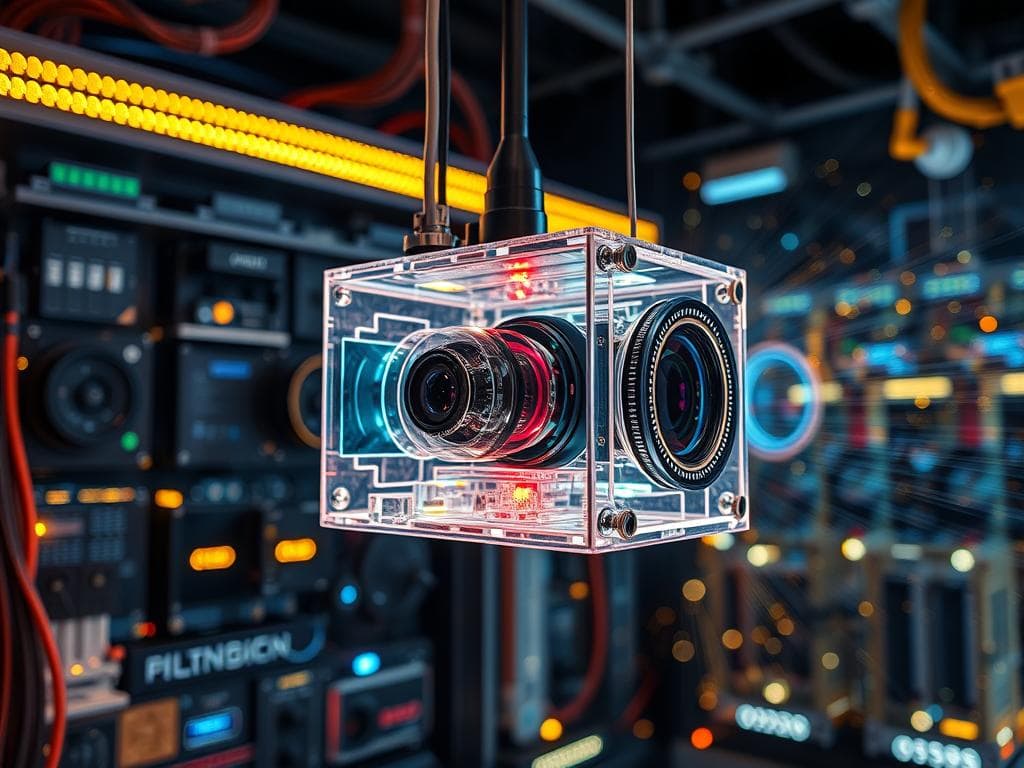
How Quantum Cameras Work
Quantum cameras are a big leap in imaging tech. They use quantum mechanics to beat old methods. They encode images with quantum links, letting them see things regular cameras can’t.
Encoding Images with Quantum Correlations
Quantum imaging starts with spontaneous parametric down-conversion (SPDC). This makes entangled photon pairs that share visual info. Unlike regular cameras, quantum ones use these pairs to capture more detailed images.
The EMCCD camera boosts sensitivity and detail in these images. It’s a key part of quantum cameras’ power.
Resistance to Disturbances
Quantum cameras stand strong against noise and optical scattering. This is because their images are encoded with quantum links. This makes them perfect for tough environments, like studying biology or working in the air.
Thanks to quantum cameras, we can get clearer images in bad conditions. Their optical stability is a big plus.
Conclusion
Quantum cameras could change how we see and capture the world. They promise to show us things we can’t see now. This is thanks to new tech in imaging.
The future of quantum cameras looks bright. They could help in many areas, like medicine and science. They might even lead to new discoveries.
Starting to use quantum cameras changes how we see things. It also opens up new areas for research. I think they will change how we look at the universe.
