Did you know some advanced heat-sensing cameras can spot temperature changes as small as 0.1 degrees Celsius? This amazing ability lets these devices show us the world in new ways. They reveal details we can’t see with our eyes.
These cameras have many uses, from keeping things running smoothly in factories to keeping us safe at home. They use infrared imaging to show us heat signatures. This helps us find problems before they get worse.
As we dive into the science behind these cameras, their everyday uses, and their limits, let’s see how thermal vision is changing the game. It’s making a big difference in how we see and interact with our world.
Key Takeaways
- Heat-sensing cameras can detect temperature changes down to 0.1 degrees Celsius.
- Infrared imaging helps reveal issues not visible to the naked eye.
- These cameras find applications in numerous fields including security and industrial maintenance.
- Some thermal cameras can spot heat signatures from over 1 kilometer away.
- Heat-sensing technology enhances safety, efficiency, and accuracy in inspections.
The Science Behind Heat-Sensing Cameras
Thermal imaging technology changes how we see heat. It uses infrared energy to show temperature differences. This technology is very useful in many areas.
Understanding Thermal Imaging Technology
Thermal imaging works because all objects give off infrared radiation when warm. Cameras can see this radiation and turn it into images. They can spot tiny temperature changes, which helps a lot in different fields.
How Thermal Cameras Work
Thermal cameras use mid- and far-infrared light, up to 14,000 nanometers. Most use uncooled sensors, which are cheaper and use less energy. Cooled sensors are better but more expensive. They show more detail but are used less often.
Applications of Thermal Imaging
Thermal imaging is used in many ways. It helps find where buildings lose heat, saving energy. It also helps doctors find health problems early, like breast cancer. It’s great for security too, spotting people even in the dark or bad weather.
Heat-Sensing Cameras in Everyday Life
Heat-sensing cameras are now key in our daily lives. They help with home upkeep and safety, benefiting both homeowners and security experts.
Utilizing Thermal Imaging for Home Maintenance
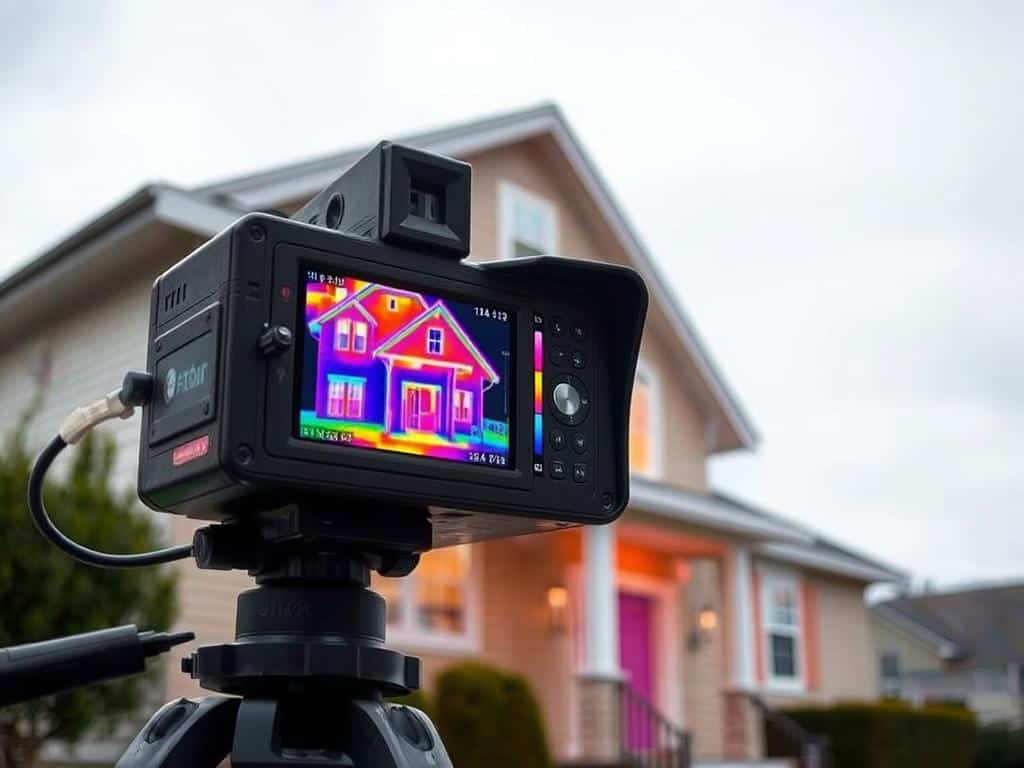
Homeowners use thermal imaging to find hidden issues like water leaks and insulation gaps. This tech spots problems that regular checks miss. It shows temperature differences on surfaces.
By finding these problems, I can make my home more energy-efficient. This could cut energy use by up to 30%. It also means my home lasts longer and my bills go down.
Role of Thermal Cameras in Safety and Security
Thermal cameras are essential for safety and security. They boost detection in dark places. Studies show a 50% better chance of catching intruders than old methods.
This helps prevent break-ins and keeps me safe at home. Thermal imaging also speeds up search and rescue by up to 70%. It’s a big help in emergencies.
Limitations of Heat-Sensing Cameras
Exploring thermal cameras reveals their limitations. These devices can’t see through many barriers that block infrared radiation. Knowing what they can’t see helps us understand their uses.
What Heat-Sensing Cameras Cannot See
Thermal cameras can’t see through clothes or most materials because of insulation. They can see through some materials like dacron or silk, but not most fabrics. For finding hidden items, millimeter-wave scanning is better, like at airports.
Thermal cameras work best when there are big temperature differences. In cold places, images might look grey or white, making details hard to see. Moisture on the lens also affects image quality. The camera’s resolution and sensitivity are key to clear images.
Misconceptions about Thermal Imaging
Many people think thermal cameras can measure body or gas temperatures accurately. But, they can only show surface temperatures, which can be wrong by hundreds of degrees. Firefighters might not know how to use these cameras correctly.
Some cameras show images in color, but this can hide important details. There’s also confusion about using thermal cameras to check temperatures during fires. The NFPA 1801 standards say not to rely on them for this, showing their limits.
Conclusion
Heat-sensing cameras have changed how we do things in many areas. Companies like Advexure have shown how thermal imaging helps with safety and efficiency. This technology makes it easier to watch over things and find dangers, whether it’s in emergencies or regular checks.
It’s important to know the difference between thermal and infrared tech. This is true for jobs like emergency services or search and rescue. Using these technologies right can make things better and help solve problems in places we can’t see well, like smoke or fog.
Looking to the future, heat-sensing cameras are getting even better. They’re getting more sensitive, clearer, and might even use AI soon. This means we’ll have more ways to use thermal imaging in our daily lives. It could change how we keep an eye on things and stay safe.
